
FCC Logística signs Equality Plan
FCC Logística signed its Equality Plan at a ceremony today in Madrid. The plan was signed by Luis Marceñido Ferrón, Head of FCC Logística, and Carlos Barón Thaidisgmann, General Manager of FCC Versia. Other executives of the company who attended: Avelino Agudín González, Director of Human Resources; Mª Eugenia Martín Díaz, Head of Labour Relations; and Ignacio León Ruíz, Director of Human Resources at FCC Versia.
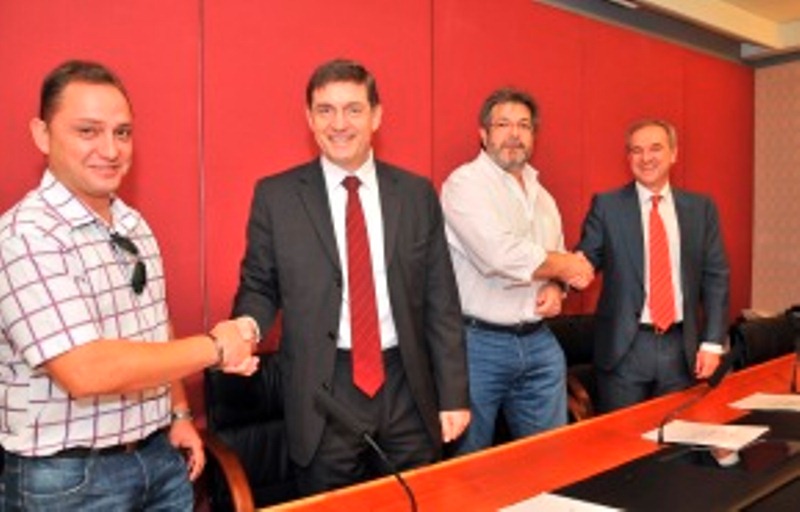
Labour was represented by Emilio Cardero Millán, Federal Secretary for Roads and Municipal Services of the TCM-UGT union, and Alberto Margalló Pascual, General Secretary of the Roads section of the FSC-CCOO union. FCC's Human Resources Department was represented by Francisco Martin Monteagudo, General Manager of HR; Emilio Hermida, Corporate Director of HR; Luis Suarez, Director of Labour Relations; and Isidoro Valverde Ballesteros, Head of Labour Relations.
The Plan, which covers approximately 4,500 people, arose to promote specific measures and goals at this subsidiary in order to extend pre-existing equality activities and campaigns into all of the group's business areas, with the support of the Corporate Labour Relations Department.
FCC Logística
FCC has identified logistics, a business that is expanding in Europe, as one of its areas of growth and diversification. FCC Logística, created by combining large business groups, obtains around 300 million euro in annual revenues.
As a leading end-to-end supply chain manager, FCC Logística provides the resources and capabilities to enable its clients to succeed; it has a significant presence in key sectors of the Spanish economy, with a strong position in the logistics market, where it has multinational clients that are leaders in their respective segments.
FCC's Equality and Diversity Management Strategy
One of the principal goals of FCC's Human Resources Department is to make the Group a standard bearer in the area of people management, diversity and equal opportunity.
The status of equality within the corporate culture has been enhanced by the strategy of negotiating and implementing equality plans tailored to the business, situation and workforce of each FCC company; as a result, FCC has taken the lead in this field in the businesses where it operates. To date, seven specific equality plans have been signed and the corresponding steering committees, comprising company and labour representatives, have been established.
The Equality Plans focus principally on access to employment, training, promotion, compensation, work/life balance and shared responsibility, measures to prevent and correct discrimination, as well as prevention and reporting of gender harassment and violence.
Additionally, Aqualia, FCC's water management company, received the "Equality Award" from Spain's Ministry of Health, Social Policy and Equality, and the group has adopted the UN Global Compact's Women's Empowerment Principles (WEPs), whose goal is to strengthen the participation of women in all areas of economic activity.
FCC also has a protocol for cases of harassment at work which is implemented automatically by a report or sign of improper behaviour.
To properly manage diversity, equal opportunity, non-discrimination and the elimination of any type of harassment, FCC has an international Diversity and Equality Committee in which the Group's principal business areas are represented.
Within its commitment to diversity, the Group is working on creating jobs for members of groups at risk of social exclusion. As a result, the Group has 1,042 employees with some degree of disability, and the agreement signed with the ONCE Foundation will enable it to hire another 150 over the next three years.
FCC has also signed an agreement with the Ministry of Health, Social Policy and Equality to assist women who have been victims of gender violence to find work, and it has agreements with other bodies, such as the Integra Foundation and Exit Foundation, to hire people at risk of social exclusion, such as certain segments of young people and women who have suffered gender violence, in addition to supporting numerous initiatives in this area, such as the Ministry's campaign against gender violence and Save the Children's campaign to raise awareness about the situation of the children of women who are victims of gender violence.