"BICISENDAS", the new CIEN project led by FCC Construcción and in which FCC Ámbito participates

"Bicisendas" is the new CIEN project led by FCC Construcción and participated by FCC Ámbito. This project will develop a sustainable, energy-efficient, intelligent, decontaminating, integrated and safe bicycle lane.
The bicycle in Spain is already used more than the bike and 4.65% of the working trips are already made in it. However, several points are still detected in surveys to improve bicycle user conditions in urban environments.
With new policies and restrictions on the use of private vehicles in favor of improvements in air quality in cities, there has been an increase in the use of alternative transports to the motor vehicle, and the bicycle begins to occupy more and more prominence in our cities. According to recent reports, about three million Spaniards used this transport almost daily for their trips in 2011. A few years ago, only a dozen municipalities had bicycle loan systems. Currently there are more than a hundred who have established this means of transport based on the loan. In most cities worldwide, as has been established, the use of bicycles is being promoted as a means of urban transport.
The known benefits of the use of the bicycle for mobility in cities are many: it reduces pollution (environmental and sound), increases local commerce, increases the value of the property close to the bike path, improves the user's health by having a longer life activates and even increases the profits derived from tourism among others.
To further encourage the use of bicycles, both private and "bike sharing" systems, this project proposes the development of new bike lanes that integrate new technologies from multiple sectors to help increase comfort, safety, the environment and communications in the bike lane environment, and in this way contribute to promote sustainable transport.
FCC Construcción has shown a fundamental interest in the development of new bike lane models, giving rise, precisely, to the motivation in this R & D & I project, approved and financed by the Center for Industrial Technological Development (CDTI) of the Ministry of Science, Innovation and Universities within the Strategic Program CIEN 2018. The consortium of BICISENDAS companies is led by FCC Construcción, and includes large companies such as FCC Ámbito, IMPLASER, Idneo, Kompuestos, Tradia and TEX Obras y Servicios. This project is supported by the City Council of Sant Boi de Llobregat (which includes its availability to carry out a demo section) and the Cycling Association "European Cycling Federation", which helps to better understand the generalized impact that the results obtained can have for the project.
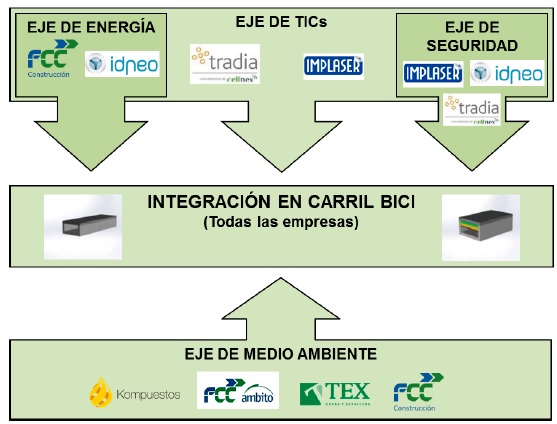
The general objective of the BICISENDAS project is the development of a new generation of bike lanes, which will be modular type, produced with sustainable materials and can be custom designed for the integration of various technologies and according to the needs that must be covered. In this way each module can be multifunctional, providing solutions to the needs not only of cyclists but of the urban environment as a whole.
The modularity also allows installation and opening to the public faster and with less discomfort in the environment, also facilitates the replacement of parts individually and the modular products can be transported expanding the potential market. The technologies to be incorporated in the modules are centered on four axes: Environment, Energy, Security and ICT (Smart Society).
The project lasts four years (2019-2023), and for its development it is supported by the most advanced universities and technological centers in the areas that constitute the project's objectives: CSIC (Higher Council for Scientific Research), University of Zaragoza , UPC (Universitat Politècnica de Catalunya), AITIIP, CIMNE (International Center of Metodes Numerics A L'Enginnyeria), LEITAT and Luderra.
Among the specific objectives of FCC Construcción in the project are:
- New applications in polymeric materials with porphyry residues (up to 70% replacement - up to 40% recycled polypropylene and up to 30% porphyry recycled in total weight of the material) and use of porphyry on surface of bicycle lane for texturing superficial non-slip.
- Obtaining a novel binder for AAM materials developed based on the use of various waste (up to 60% of waste rich in SI / Al) and supplemented with industrial by-products.
- Two new types of AAM materials (dense mix and porous mix).