
The 2015 economic situation and the 2016 outlook of the International Monetary Fund
The International Monetary Fund (IMF) forecasts the global economy to grow 3.4% and 3.6% in 2016 and 2017, respectively.
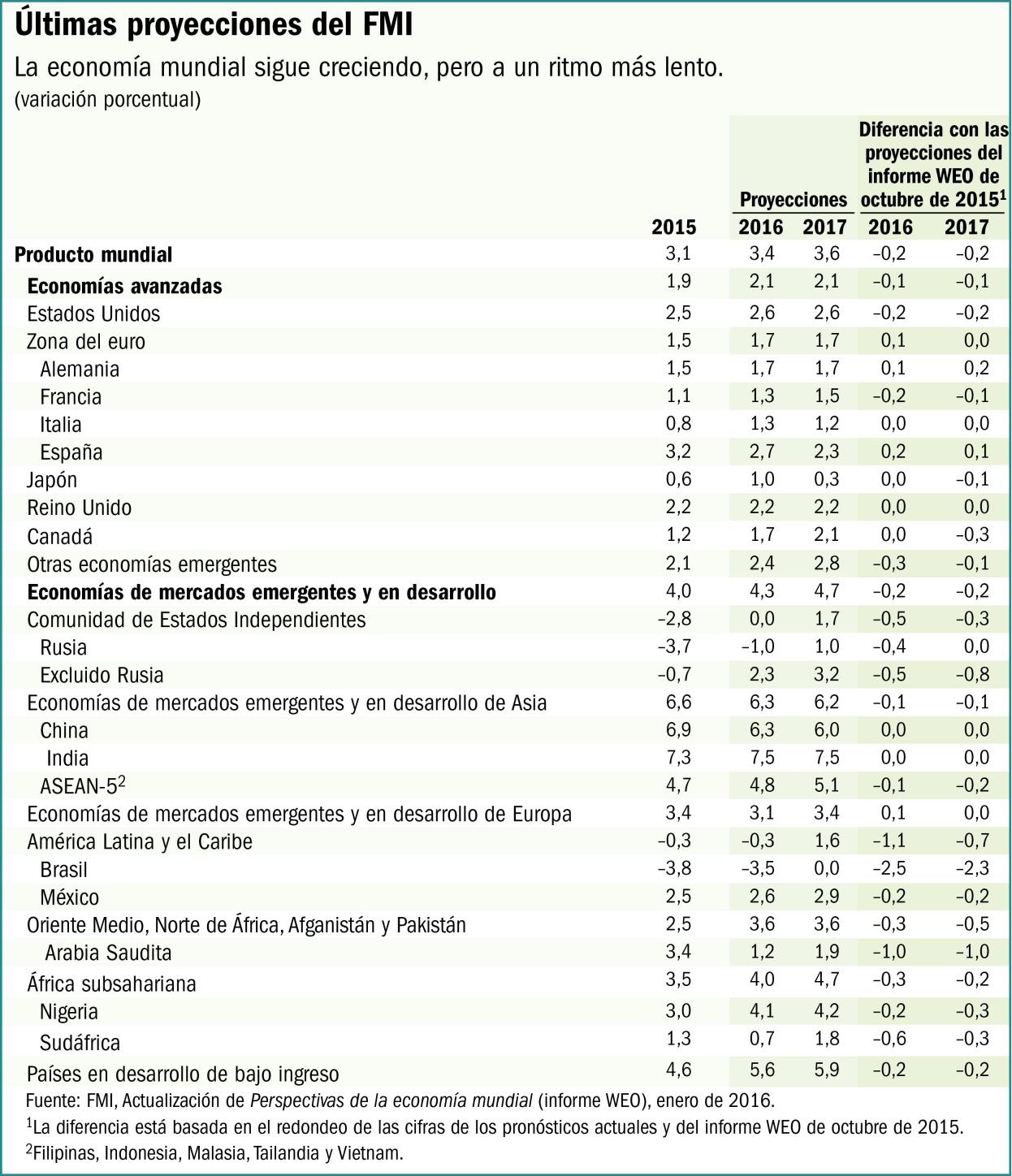
This forecast, although positive, has been downgraded by around 0.2 percentage points, mainly because the economic recovery of emerging countries is now expected to be weaker than initially anticipated. The fall in oil prices and in other raw materials weighs heavily on many emerging economies and on parts of world trade as many producer countries are forced to reduce the pace of their external purchasing. However, it could bring a greater than expected boost in demand in oil importing countries.
In general, the IMF forecasts that recovery in global economic activity will be fairly gradual, "particularly for emerging markets and developing economies".
The said emerging markets and developing economies slowed down in 2015 for the fifth consecutive year, despite the fact they still generate over 70% of world growth. Advanced economies, however, continued to register a modest recovery.
According to the IMF, there are three factors that continue to shape the global outlook: the slowdown and gradual adjustment of China's economic activity; the slow tightening of the US monetary policy, while the central banks of other advanced economies continue applying a relaxed monetary policy; and, finally, the market drop in energy and other raw material prices since September 2015 as a repercussion of the falling oil prices.
The growth projection of the Eurozone as a whole is 1.7% in 2016 and 2017.
The US economy will grow 2.6% in 2016 and 2017, say IMF experts.
Regarding the Latin America and the Caribbean economies, the aggregated GDP of the region as a whole will contract 0.3% in 2016 and will grow 1.6% in 2017. Nevertheless, growth in the majority of countries in the region will be positive. The contraction is mainly due to the situation in Brazil. Its recession is deeper and more prolonged than expected, caused by political uncertainty amid interruptions in the Petrobras investigation. The IMF estimates that the Brazilian economy will slump 3.5% in 2016 and will recover in 2017. The growth projections for Mexico continue at a rate of 2.6% in 2016 and 2.9% in 2017.
The outlook for the Middle East is rather gloomy due to falling oil prices.
The growth projections for China hit 6.3% in 2016 and 6.0% in 2017.
IMF experts forecast Spain's GDP to grow 2.7% in 2016 and 2.1% in 2017.