The SAFETY4D R & D project started, led by FCC Construcción, where a high performance process for the prevention of occupational risks in construction is developed based on the BIM methodology
Construction is one of the productive sectors with the highest risk of accidents at work and, therefore, traditionally more punished by occupational accidents. As for accidents of a serious or fatal nature, the situation is even harder for this sector.
One of the basic objectives of FCC is to work with quality, and to perform a job well done it is necessary to work safely. These parameters of quality and safety can be achieved by incorporating BIM into the field of safety and health. The determination of the BIM methodology in the industry can change the way in which the security is applied, integrating it in an effective way in the construction processes, detecting and allowing to automatically reduce the dangers even before the execution of the works.
Safety planning usually consists of the identification of risks, as well as the choice of appropriate safety measures to avoid them. The precise identification of security risks and their potential is fundamental to the security planning process, often carried out separately from the planning of project execution. This separation and lack of communication between the different actors involved creates difficulties for security professionals to analyze what, when, why and where security measures are needed to prevent accidents.
As a result of this motivation, the SAFETY4D project has been launched, approved by the Industrial Technological Development Center (CDTI) of the Ministry of Science, Innovation and Universities, and whose consortium is led by FCCCO, in collaboration with the Engineering company. INGECID. The main objective of the SAFETY4D project is the development of a new advanced high-performance process for the prevention of occupational risks in construction that allows the improvement of risk prevention, and with it the reduction of the risk of accidents in the field of construction, without this implying a greater investment of resources by companies. For the development of the prevention process, a methodology will be designed together with a tool that allows the management of preventive measures and protective equipment of companies through the BIM methodology. The development of the project is scheduled to take place over two and a half years (2019-2021).
To achieve a high performance in risk prevention, it is not possible to act on only one of the phases of a work, that is why this objective is broken down into two main technical objectives:
- Analysis of the management of prevention systems at the planning level.
- Design of the management of prevention systems during the execution phase.
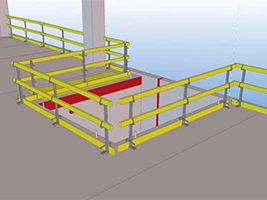
The use of the BIM methodology enables the automation of the process for the prevention of occupational hazards, said automation being the main technological challenge. The incorporation of technical planning to the BIM models (known as BIM 4D) will allow to detect graphically where prevention systems could be necessary in each execution task, allowing greater control over them, both in time and space.
Among the specific objectives of the project are:
- Ensure the detection, during the planning phase, of all existing risks and the required prevention systems, in compliance with the regulations and recommendations of good practice
- Presenting the user with regulatory alternatives and based on recommendations of good practice, facilitating decision-making, ensuring the selection of the most appropriate prevention systems for each specific work
- Facilitate the detection of incompatibility during planning, avoiding possible interference in space and time that may occur due to the presence of security systems
- Facilitate the management of prevention material throughout planning
- Allow to visualize the location in space and time of those risks that are not completely avoidable or that have associated more serious accidents
- Generate a specific report for the Health and Safety of the work, with specific graphic information of the work, which facilitates the understanding on the part of the supervisors and those responsible for the execution of the work