
The FAST consortium reaches 20 million hours worked without accidents
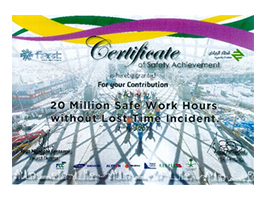
The FAST consortium, led by FCC Construcción, has obtained the certificate of 20 million hours worked without accidental work, in the Linea 4, 5 and 6 project of Riyadh Metro (Saudi Arabia).
This milestone has been achieved, due to the high safety standards implemented in the work, by the commitment of all the members of the consortium in the adoption of safety and health as a priority in the execution of the suburban transport infrastructure.
The first test on lines 4, 5 and 6 of the Riyadh Metro (Saudi Arabia) has recently been successfully developed. The tests include the demonstration of the performance of the railway system, from the power supply to the signaling systems, making use of the trains delivered by Alstom to the consortium.
FCC Construcción and expansion of Metro Line 4
A few months ago, the FAST Consortium was awarded the extension contract for Line 4 of the Riyadh Metro, with two additional stations, which will provide service at King Khalid International Airport (KKIA).
The extension includes the construction of a 1.5 kilometer-long viaduct and two elevated stations with direct access, through elevated footbridges, to terminals 1/2 and 3/4 of the international airport of the capital of Saudi Arabia. In this way, Line 4 of the Riyadh Metro will connect directly the future financial center of the city (King Abdullah Financial District - KAFD) with the KKIA, which makes it a key corridor for the development of Riyadh urban transport. The execution of the stations and associated infrastructures by the FAST Consortium will allow passengers to benefit from a direct transport link to the airport.
The FAST Consortium builds Lines 5 and 6 of the Riyadh Metro, in addition to the aforementioned Line 4, which is a milestone for Spanish engineering, as it is the most important infrastructure contract in history for a company in our country. Currently the project is reaching milestones as important as the electrification of the depots of Lines 4 and 6, which recently allowed the first test of the trains in automatic mode.