
FCC Construcción wins the Caminos Madrid award for its project, remodelling of Nudo Norte (Madrid)
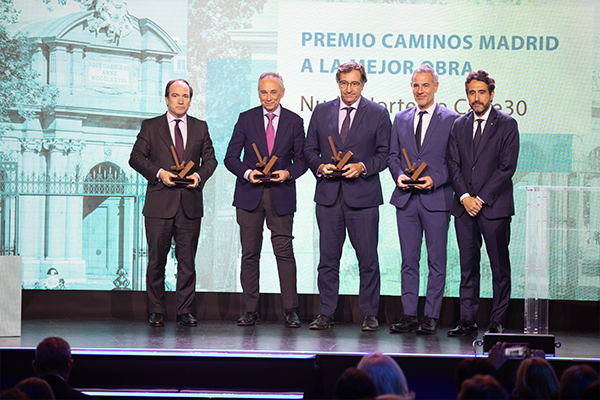
FCC Construcción has won the Caminos Madrid award for its project, remodelling of the Nudo Norte (Madrid), as part of the 16th Annual 2023 Awards. These awards are in recognition of civil engineers, whose work is fundamental to economic and social development, and of projects that modernise and make the city of Madrid and its community more sustainable.
The project aimed to reduce traffic congestion at rush hour in this enclave of Madrid, as its influence affects the rest of the city, connecting with the M-607, the Avenida de la Ilustración; M-30 west; Paseo de la Castellana; A-1; M-11; M-30 south and Fuencarral-Malmea.
The reform of this infrastructure is one of the "key actions" that were included in the Madrid 360 Environmental Sustainability Strategy to help reduce polluting emissions in the city. The Nudo Norte is one of the points, together with the Manoteras junction, with the highest traffic intensity in Spain: it is used by more than 270,000 vehicles a day, according to the Madrid City Council.
It is used by 34,000 vehicles a day during the morning rush hour, from 8:00 to 9:00, and 33,800 vehicles during the evening rush hour, from 18:00 to 19:00.
The North Junction of the M-30 constitutes a high-capacity road axis where the M-30 and the M-607 (Colmenar Viejo motorway), the Paseo de la Castellana, the M-11 and the A-1 converge via braids. The section between this junction and the project contemplates the adaptation works on all its connections.
The formula involved the elimination of the four junctions, which are the ones that caused the loss of track capacity and major traffic jams. These four crossings at the same level were replaced by new crossings at different levels: three are underpasses and one overpass, the one on the M-607 with a connection to Paseo de la Castellana.
The roads were also rearranged and some of the existing viaducts were adapted and enlarged. In addition, the remodelling was aimed at improving road safety and accessibility to public transport and existing services, reducing journey times.
Increased capacity at critical points and the elimination of junctions has reduced congestion levels to below 70 percent. In addition, this reform has improved air quality, reducing CO2 emissions by an average of 14 tonnes per day, equivalent to 0.5 per cent of CO2 emissions from the road transport sector in Madrid.