
FCC Construcción collaborates with different certifications of R+D+I actions
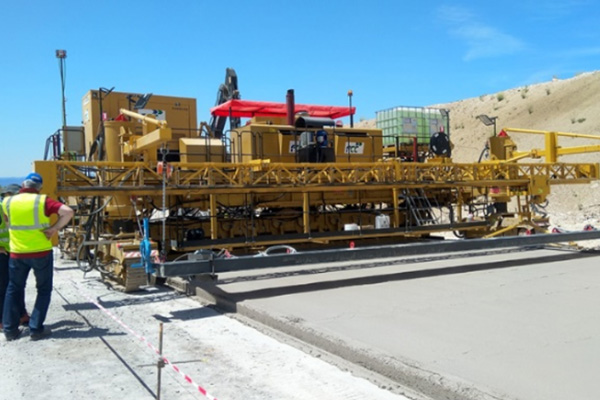
The National R&D&i Department is responsible for the certification process for innovative actions originated in the various work sites, once these actions are completed. In this certification process, work sites are involved in each project in a voluntary collaboration. Without their collaboration it would not be possible.
This entire certification process is key for the company as it allows:
- To be able to accredit R&D&i projects in works tenders and other contracts in these types of activities, providing additional points in some Authority tenders.
- To get tax deductions for R&D&i in corporate tax.
- To increase the R&D&i activity scope in the R&D&i Management System certificate in accordance with UNE Standard 166002:2021 Certificate.
In this last year, the following 2021 certifications have been completed:
A-33 HIGHWAY: STRETCH: C-3223 CONNECTION TO YECLA – N-344 CONNECTION: “EXECUTION OF A CONTINOUS REINFORCED CONCRETE PAVEMENT IN TWO LAYERS “:
“TECHNOLOGIC INNOVATION” certification has been obtained thanks to the help and collaboration of Yecla Project team and the Materials and Pavements Department in the Technical Services of FCC Construcción.
The project consists of the execution of a continuous reinforced concrete pavement, corresponding to section 034 of Instruction 6.1 IC Pavement Sections. The pavement is made up of 24 centimeters of concrete in two layers, executed with the “fresh on fresh” system, according to which a first paver executes the lower layer of 19 centimeters, and then a second paver executes the 5 centimeters of the upper layer. The practically simultaneous construction of both layers of concrete allows them to adhere perfectly to each other, obtaining a single section with a total thickness of 24 centimeters.
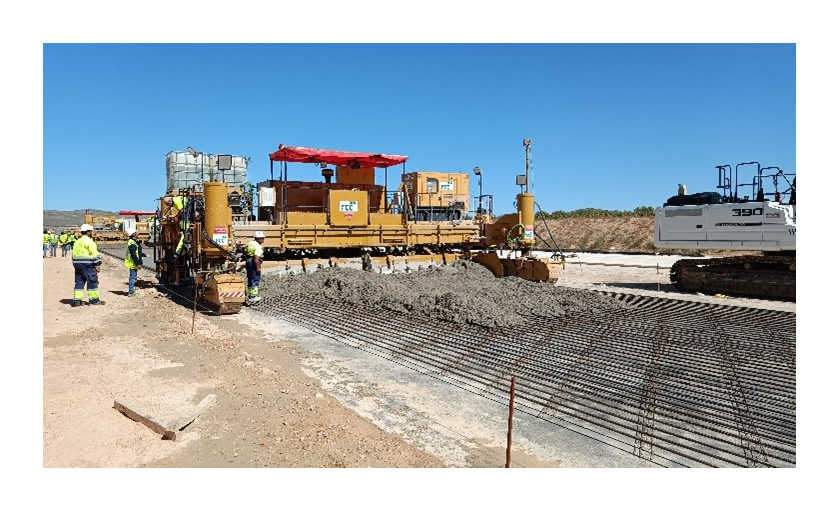 In order to achieve adherence between the two layers of concrete, a perfect coordination between the concrete manufacturing equipment and the paving equipment is necessary, as well as a correct synchronization between both pavers.
The two-layer pavement allows different types of concrete with different characteristics to be placed in each of these layers. In this way, the use of aggregates with greater resistance to polishing is limited to 5 centimeters of the upper layer, which is the one in direct contact with traffic, thus making a more efficient and respectful consumption of natural resources.
The type of texture established in the Project is the so-called "exposed aggregate surface", which consists of exposing the coarse aggregate of the concrete of the upper layer. To do this, an additive to delay the hardening of the most superficial millimeters of the pavement is spread, so the mortar can be removed by vigorous sweeping and the aggregate of the upper layer is exposed.
This type of texture is characterized by allowing rapid evacuation of rainwater from the road and the production of less rolling noise compared to traditional textures of concrete pavements.
RENOVATION OF SANTIAGO BERNABÉU STADIUM: "INNOVATIVE DESIGN AND DEVELOPMENT OF A STEEL STRUCTURE, FORMED BY HYBRID TRIANGULATED BEAMS":
It has been certified as "TECHNOLOGICAL INNOVATION" thanks to the help and collaboration of the Bernabéu Project team and the Special Works Department in the Technical Services.
In 2021 the assembly of Santiago Bernabéu Stadium’s fixed roof, initiated in 2020, was continued.
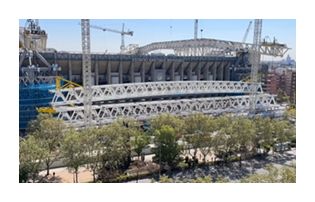 This year the project focused on the innovative assembly of the fixed roof on the east side of the New Santiago Bernabéu Stadium.
The assembly of both cross trusses, rolling and lateral, was carried out, initially, beside the west façade (Castellana). Once they were fully assembled, they were transferred to their final position, beside east façade (Padre Damián), on two bogeys that supported both east-side cross trusses. The four bogeys (two for each cross truss) run on two rails attached to both main trusses.
Both cross trusses were assembled beside the west façade, resting on a raised platform supported by a mixed structure (steel and concrete).
Once assembled, the trusses were lifted, one after another, using a heavy lifting equipment installed on bogeys. Initially, the bogeys were placed on the main trusses’ extensions, above the position of the cross truss located nearest to the west façade.
After the cross trusses had been hoisted and attached to the bogeys, the auxiliary lifting equipment was disassembled. The first lifted truss was moved to a temporary position in order to keep the distance established in the project between both trusses.
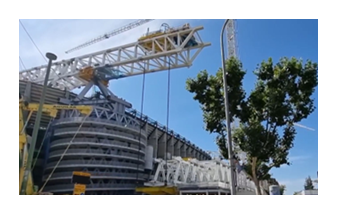 In this temporary position, the secondary tubular trusses and their bracings were assembled between both cross trusses, besides the rest of the east fixed roof structure.
At that point, the structure was still suspended over the west side stands of the stadium, at about 70 m high and with a weight of approximately 2,100 tons. Once completed, the whole east structure, leaning on the bogeys, had to be moved along the main trusses 157 m, in order to reach its final position, describing a trajectory with changes of slope that ranged from +11,7% at the beginning to -11% at the end, and that also included horizontal stretch.