FCC Construcción completes the R&D&I SEIRCO (Intelligent Expert System) project for risk assessment and training in the construction sector
FCC Construcción finishes research for the SEIRCO project (Intelligent Expert System for Risk assessment and training in different settings within the Construction sector), which primarily aims to research and develop new technology within this area, thereby equipping the current prevention systems with new technical capacities which minimise the accident rate in this sector.
The work team, led by FCC via the Department of Risk Prevention for the Local Office of Galicia, Castilla y León and the Prevention Service for the Sub-Directorate General of Technical Services, was formed by a consortium also comprising Isolux Corsán as construction company; Imatia Innovation as software development company; Femxa Formación as a company specialised in training courses; and Segurinco as a company committed to risk prevention and safety on construction works.
The project began in April 2013 with a budget of 459,223 euros granted to FCC Construcción by the Centre for Industrial Technological Development (CDTI) of the Ministry of Economy and Competitiveness.
As the basis of the project, work was carried out around two lines of action:
- Obtaining greater knowledge and control of the current risks in construction activity, as well as the costs deriving therefrom, thanks to the research and development of an innovative method of Knowledge Discovery in Databases (KDD) which works out the actual probability of having a certain accident under specific conditions. To do this, research was carried out on techniques based on artificial intelligence, automated learning and statistical hypotheses, which help to find risk patterns in large volumes of data.
- Increasing awareness levels of works staff by researching and developing new technologies which facilitate the creation of training courses based on virtual reality. To do so, research and development of an advanced framework of automatic generation of dynamic virtual realities was carried out, which helps to create customised courses in the quickest way possible.
The research, led by the Department of Natural Resources and Environmental Engineering of the Faculty of Mines at the University of Vigo and the DASA group (Design and Automation of Advanced Systems), entailed a comprehensive risk analysis of the sector. This project consisted of a case study, the collection of data and its subsequent analysis, processing and cleansing. This helped to retrieve a database that was modelled via a study of various statistical methods in order to obtain a data model which could provide important risk patterns in settings within the construction sector.
By using this modelling, which was carried out in a certain number of major work units, it was possible to feed the SEIRCO tool, which consists of a software platform that not only manages the risk prevention of companies, but also incorporates the entire training plan on the scope of health and safety in the work project.
SEIRCO will allow companies to improve their Risk Prevention in the Workplace department by adding value to the area of management and training, attempting to serve as a conductive way to improve certain aspects of the current work as well as improving conduct, behaviour and actions regarding the risk affiliated with construction works. All with the aim of maximising safety and reducing the probability of current accidents.
It is worth pointing out that SEIRCO is a scalable platform and, even though it currently has an important database modelling, the aim is to progressively feed the database so as to train the system and adjust the associated values. It also offers many possibilities to potential users, web environments and applications for smartphones and tablets, which will allow them to improve their Risk Prevention in the Workplace systems with major technological advancements.
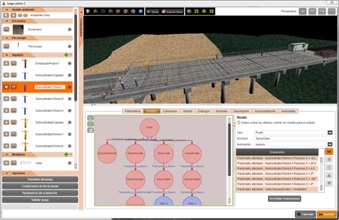
Finally, one of the main features of the platform is the incorporation of a game simulator with a 3D graphic component. It broadens the training level's potential by recreating risk scenarios and allowing the player to interact, make decisions and learn from the results of these actions.
Thanks to this project, very interesting statistical results are obtained which in turn help to improve current accident rates.
The research, led by the Department of Natural Resources and Environmental Engineering of the Faculty of Mines at the University of Vigo and the DASA group (Design and Automation of Advanced Systems), entailed a comprehensive risk analysis of the sector.
This project consisted of a case study, the collection of data and its subsequent analysis, processing and cleansing. This helped to retrieve a database that was modelled via a study of various statistical methods in order to obtain a data model which could provide important risk patterns in settings within the construction sector.
By using this modelling, which was carried out in a certain number of major work units, it was possible to feed the SEIRCO tool, which consists of a software platform that not only manages the risk prevention of companies, but also incorporates the entire training plan on the scope of health and safety in the work project.
SEIRCO will allow companies to improve their Risk Prevention in the Workplace department by adding value to the area of management and training, attempting to serve as a conductive way to improve certain aspects of the current work as well as improving conduct, behaviour and actions regarding the risk affiliated with construction works. All with the aim of maximising safety and reducing the probability of current accidents.
It is worth pointing out that SEIRCO is a scalable platform and, even though it currently has an important database modelling, the aim is to progressively feed the database so as to train the system and adjust the associated values.
It also offers many possibilities to potential users, web environments and applications for smartphones and tablets, which will allow them to improve their Risk Prevention in the Workplace systems with major technological advancements.
Finally, one of the main features of the platform is the incorporation of a game simulator with a 3D graphic component. It broadens the training level's potential by recreating risk scenarios and allowing the player to interact, make decisions and learn from the results of these actions.
It is worth noting that thanks to this project, very interesting statistical results are obtained which in turn help to improve current accident rates.