
FCC Construcción wins the remodeling of the Nudo Norte
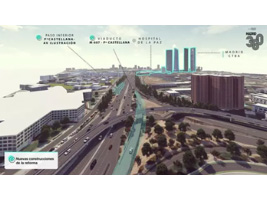
FCC wins the remodeling of the Nudo Norte. This remodeling constitutes one of the main actions that will set the starting point for the future urban development “Distrito Castellana Norte”.
The North Junction of the M-30 constitutes a high-capacity road axis in which the M-30 and the M-607 (Colmenar Viejo highway), the Paseo de la Castellana, the M- 11 and the A-1, the section between this junction and the Manoteras junction being one of the busiest in Spain. 34,000 vehicles pass through the whole of the Nudo Norte daily during the morning rush hour (from 8 am to 9 am), and 33,800 vehicles in the afternoon peak period, from 6 pm to 7 pm. This road junction is used by more than 270,000 vehicles a day.
The project contemplates the adaptation works of the North Node in all its connections. The objective of this action is to reduce traffic congestion at rush hour in this enclave of Madrid, since its influence affects the rest of the city. The formula goes through the elimination of the four braids, which are what cause the loss of track capacity and large traffic jams. These four crossings at the same level will be replaced by new crossings at a different level: three are lower and one higher, that of the M-607 with connection to Paseo de la Castellana.
The roads will also be rearranged, as well as the adaptation and expansion of some of the existing viaducts. In addition, the object of this remodeling is the improvement of road safety and accessibility to public transport and existing services with the reduction of times.
Less time behind the wheel
According to studies carried out by the Environment and Mobility Area, the average time by car to cross the Nudo Norte at rush hour is 3.16 minutes. With this reform, it is expected to save time at rush hour of 31% in trips in private vehicle. In total, 3,667 hours per day will be saved.
Increasing capacity at critical points and eliminating crossings will reduce congestion levels to below 70%. In addition, this reform will improve air quality, reducing CO2 emissions by an average of 14 tons per day, which is equivalent to 0.5% of the CO2 emissions of the road transport in Madrid.
This work is part of the measures of the Madrid 360 Environmental Sustainability Strategy with which the Madrid City Council will comply with the air quality limits established by the European Union. In addition, it is the first work that the Madrid City Council will execute with BIM (Building Information Modeling) technology, from the drafting to its construction and subsequent conservation and maintenance.