
FCC Construcción participates in the inauguration of the “Reforma Plaza España” project (Madrid)
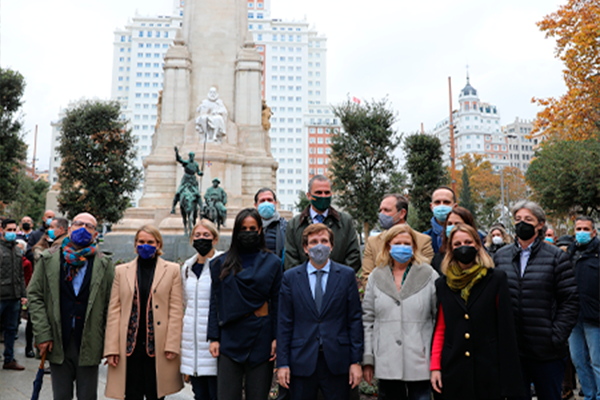
FCC Construcción has actively participated in the inauguration of the reform project for the “Plaza de España” in Madrid. The mayor of the city has inaugurated the new Plaza de España and its surroundings after the reopening of this emblematic space two and a half years after the reform works began, which have involved an investment of 74.4 million euros in the which is, together with Madrid Río, one of the main transformations of the city in this century. The mobility of the area thus regains normality both on the surface and in the tunnel, which has also been reopened to traffic after its expansion. Along with the mayor, the Deputy Mayor, Begoña Villacís; the delegate of Works and Equipment, Paloma García Romero, and several members of the municipal government and representatives of municipal groups, as well as residents, businesses, hotels and schools in the area.
The new Plaza de España, which is called to be a new tourist center of the city, gives rise to a greener, more sustainable and accessible environment that changes the appearance of the center of the capital, a space of more than 70,000 m2 that integrates all the modes of mobility, but that prioritizes the pedestrian. In this sense, one of the fundamental objectives of the reform has been the pedestrianization of the Bailén-Ferraz axis to materialize the connection between the valuable public spaces in this environment that until now had been segregated.
In this way, the underground infrastructures created allow not only the pedestrian and cyclist permeability from the Plaza de Oriente to the Plaza de España and the Temple of Debod, but also the connection with the Sabatini gardens, the Campo del Moro and even Madrid Río . The new square thus becomes the green door to a transversal mesh that comes from the Manzanares river and establishes a point of environmental penetration towards the center of the city. An environmental quality that is also enhanced with the planting of more than 1,100 new trees.
The great transformation of this space has been possible thanks to the channeling of road traffic through a tunnel that allows traffic to be transferred to the lower level of the overpass built in the 60s and to gain surface space for pedestrians.
The tunnel resulting from the reform connects road traffic from Bailén Street to Ferraz Street. The new part of this tunnel is a continuation of the existing one and goes from the beginning of the Sabatini gardens, on Bailén Street, to Ferraz Street, beyond Ventura Rodríguez. The union of both tunnels generates an underground infrastructure of more than 1,150 meters from its entrance in Bailén, at the height of Calle Mayor, to the exit of Ferraz. In addition, it has a connection with the San Vicente slope, which allows you to go both to the M-30 and to the Gran Vía.
Improving cycling mobility is another of the axes of the new space, since it connects the north-south and east-west axes of the area in a segregated way. The segregated bike path, which runs over an area to which the private vehicle does not have access, connects Ferraz Street with Bailén Street, stitching the cycle paths of San Quintín Street with those of Ferraz Street and Paseo del Pintor Rosales. For its part, the other east-west cycling axis connects the San Vicente slope with the Gran Vía through a segregated lane that runs alongside the road under the pedestrian platform.
This configuration turns the Plaza de España into a connector for cycling networks capable of linking itineraries that until now were disconnected. In this way, no movement is devoid of the possibility of being traveled by bicycle. In total, more than three kilometers of cycle paths have been implemented on carriageways and almost 400 meters of cycle path on car-free spaces.
Until now, the square lacked measures that made possible the safe movements of people with mobility or reduced vision, cognitive limitation or any other disability or difference. In this sense, it was an obsolete space. The new Plaza de España, however, has the necessary conditions to guarantee its full use by all types of people, regardless of their abilities.
In addition, the project will integrate most of the archaeological remains found during the excavations for the construction of the Bailén-Ferraz tunnel, such as the two floors of the Godoy Palace and the buttresses of the old Royal Stables next to the current Sabatini Gardens, as well such as the remains of the 'round path' of the old San Gil barracks. These remains will not only be able to be visited by citizens and scholars, but an archaeological itinerary will also be implemented and an interpretation center of the monumental cornice will be built to explain and help understand the evolution of the city very close to the place of its birth.