
FCC Construcción participates together with Puertos del Estado in the presentation of the new Strategic Framework for Spanish ports
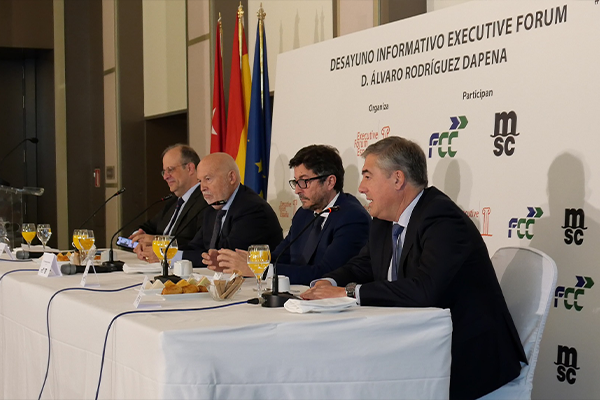
FCC Construcción has participated together with the president of Puertos del Estado in the presentation of the new Strategic Framework for Spanish ports.
The president of Puertos del Estado, Álvaro Rodríguez Dapena, in his presentation, analyzed the role of Spanish ports in European and global logistics networks, as well as presented the challenges currently facing the national port system from the point of view economic, environmental and social.
The director of Spain, Portugal and the industrial area of FCC Construcción, Jose A Madrazo, expressed the relevance of public-private collaboration in promoting port-maritime development, since this sector is a "basic support" that has a direct impact in economic and social development in general. "Any port in the Spanish network is a good example of the importance of this collaboration," he pointed out, which is why he has encouraged us to continue advancing along this path to face the challenges faced by maritime traffic, such as the search for spaces and of a new world geographic center, the development of new technologies, decarbonization, the implementation of renewable energies or the "pending issue of rail access", among others.
At the beginning of his speech, Rodríguez Dapena presented a structural analysis of the Spanish economy with the aim of justifying the exponential growth that he has achieved in recent decades. Among the factors that would explain this development, the president of Puertos del Estado has pointed out two: the Spanish incorporation into the European Union and the integration of our ports in the process of globalization and exchange of goods with other continents.
Globalization and shipping
Precisely, with respect to this last factor, he highlighted that the globalization of merchandise exchanges has allowed an extraordinary development and growth of the Spanish maritime-port area, a process in which "shipping companies have had a lot to do, we owe them connectivity with the rest of the planet. "Today a very important concentration is taking place in each sector" he continued explaining, "any type of activity with a global logic tends to concentration". In this sense, he added that shipping companies are a good example of this logic, thanks to the development of two relevant policies that they usually represent: the progressive repowering or replacement of fleets to deal with decarbonization and vertical integration. "There is a door-to-door in which the container, symbol of the revolution in the maritime world, has become the lever by which this integration occurs" he added.
This context leads us to "from the port authorities we have to reach an alliance, a public-private collaboration in which the benefits of each one are put on the table." Thus, he has stated that the general mentality of the port authorities, and his own, consider that the public sector should be a co-entrepreneur with the private sector, serving the general interest.
Strategic Framework
"The new Strategic Framework puts the environmental, social and economic dimensions on an equal footing," recalled Rodríguez Dapena. "They are all aligned, they are not opposed." In this sense, he has emphasized the importance of advancing in public-private collaboration in these three dimensions, admitting that in the economic part "we already have it internalized", so it is necessary to continue advancing in the other two.
Thus, the president of Puertos del Estado has also referred to the importance of developing the infrastructure of Spanish ports, since "intelligence is not so much in the linear, but in the nodal, where information and data are concentrated" . In his opinion, it would not only be a question of digitizing the infrastructures and administrative processes of the ports, but of pooling the data of all the port agents to give rise to "a port that also works in the infrastructure in real time, being susceptible to being forced to go making decisions, either in the exploitation or in making decisions anticipating the future”.