
FCC Construcción participates in the King Felipe VI business meeting in Qatar
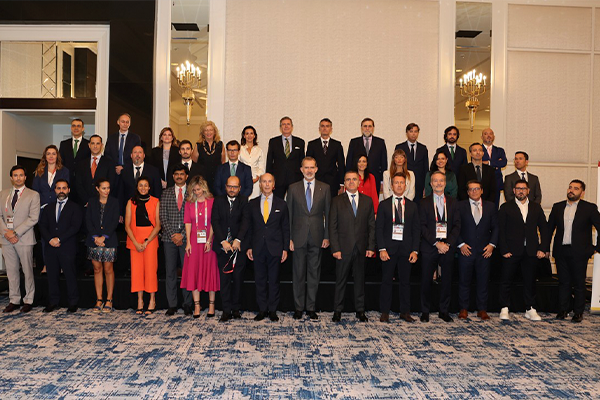
FCC Construcción has participated in the business meeting held in Qatar and chaired by King Felipe VI. Representing FCC Construcción was Yago Mijangos, director of the Middle East and West.
More than thirty representatives of Spanish companies attended the business meeting. King Felipe VI was accompanied by the Spanish ambassador in Qatar, Javier María Carbajosa, and the president of the Spanish Chamber of Commerce in Qatar, David Quintanilla.
Representatives of companies such as Acciona, Applus, Técnicas Reunidas, Sener, LaLiga, SACYR, Iberdrola, Grupo Dani García, Padel Club or Integra Agricultura participated in the meeting, as well as other smaller companies from different sectors, who thanked His Majesty for his presence. in Qatar for what it means to support its commercial work in this country.
In bilateral economic and commercial relations, Spain has traditionally had an offensive interest in winning the award of contracts to companies established in Qatar.
The departure of Spanish construction and engineering companies from the country, as well as the importance of Qatar's investments in large Spanish companies (especially in the retail distribution, press, financial, energy and residential sectors) are balancing the balance.
It should be remembered that, within the framework of the State visit of the Emir of Qatar to Spain in May 2022, both countries have elevated their political relations to the level of strategic association, which will imply the launching of a regular political dialogue to monitor of the Agreements. This will be positive for economic relations between the two countries.
Qatar is one of the richest countries in the world thanks to its natural resources in gas and oil. The state of Qatar is the third largest producer of natural gas in the world and the largest in Liquefied Natural Gas (LNG), exporting 75% of what is produced.
The state of Qatar owns hydrocarbon resources, a sector that represents 36% of GDP. The state manages these resources through the public company “Qatar Energy”, which has the rights to exploit the industry. Among the main products obtained from extraction are natural gas and oil. Qatar has allocated numerous material and technological resources to produce other hydrocarbon by-products such as propane, butane, condensate and other refined oil.
It is also worth noting the construction industry, which since 2010 and on the occasion of the 2022 Soccer World Cup has had a great development. The necessary infrastructures for holding such an event have included the construction of eight stadiums, several hotels, roads, public spaces and other infrastructures, for an estimated cost of USD 200,000 million. As the projects have been completed, there has been a slowdown in the sector.
The employment rate is practically nil. Up to 90% of the active Qatari population is employed by the public administration.
In 2021 growth was 1.5%. According to the World Bank, Qatar's growth forecasts are favourable: 4.8% in 2022 and 4.9% in 2023. In the short term, its economy will be favored by the increase in hydrocarbon prices and the increase of the demand for services during the Soccer World Cup. This expansion will continue in the next five years, possibly with growth rates in the range of 2%-3% of GDP. The main driver will be the increase in LNG production capacity.
The value of bilateral trade increased in 2019 to €1,308 million, despite the drop in Spanish exports. In 2020, due to the consequences of Covid-19, bilateral trade fell to €742M, with Spanish exports to Qatar reaching €365M and imports from the Emirate reaching €377M. In 2021, there has been a recovery towards pre-pandemic figures in the value of trade up to €989 million, after increasing Qatar's exports by more than 40%, motivated by exports of hydrocarbons and the increase in value of these.
Qatar is a strategic partner for Spain for the supply of liquefied gas to our country. Qatar is currently our fifth supplier of natural gas (6.3% of our total gas imports).
A fundamental pillar of the Qatar National Vision 2030 is energy diversification through investments in photovoltaics and grey, blue and green hydrogen (target 20% renewables by 2030). At the beginning of 2023, multiple projects will begin to be tendered, which represents opportunities for companies installed in the country (Técnicas Reunidas, Iberdrola or Acciona) or in the Gulf region, since these are energy projects still in very early stages of development. , and with a very high potential.