
FCC Construcción presents a good circular economy practice
On June 2, the Government approved the Spanish Circular Economy Strategy (EEEC) "Spain Circular 2030", which lays the foundations to overcome the linear economy and promote a new production and consumption model in which the value of products, Materials and resources are kept in the economy for as long as possible to improve efficiency in the use of resources, reduce the generation of waste and make the most of those whose generation could not be avoided.
But meeting the challenge of achieving the transition to the circular economy requires coordinated and responsible activity between Administrations, economic sectors and society as a whole. That is why, from the General Sub-Directorate of Circular Economy (SGEC) of the General Directorate of Quality and Environmental Assessment of the Ministry for the Ecological Transition and the Demographic Challenge, it is intended to promote the exchange of Good Practices in Circular Economy (BPEC) between the main agents involved, so that synergies are created that favor said transition.
FCC Construcción has presented a good circular economy practice to be included in the II BPEC Catalog, which will collect those actions that contribute more effectively to the implementation of the CE.
The work of the general interceptor collector of the river Asón, between the towns of Ampuero and Colindres (Cantabria), runs close to the channel and crosses areas where vegetation grows abundantly. To carry out construction tasks, it is necessary to clear the work area, which is why a high volume of plant waste is generated that is not usually used.
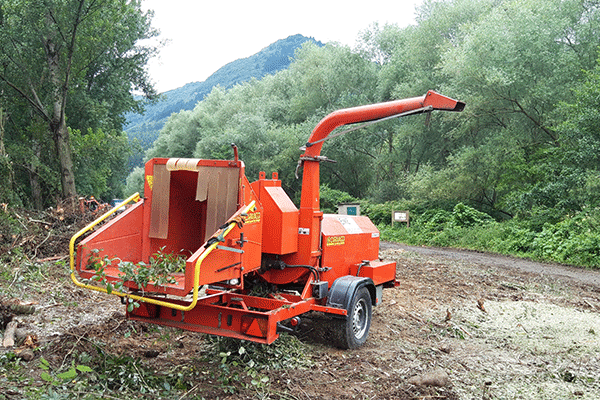
To solve this, instead of managing plant debris as waste, the work team set itself the objective of preventing their destination from being a final disposal in a landfill, reusing plant debris as fuel, substrate or ornamental element. To this end, the larger diameter logs were distributed among the local population so that they could use them as energy fuel in kitchens and fireplaces. On the other hand, to manage the branches and shrub vegetation, a firewood shredding equipment was used; The material resulting from the process was added to the biomass stockpiles that are used as substrate on the ground.