
FCC Construcción and FCC Medio Ambiente take part in the breakfast briefing given by Madrid City Council's Town Planning, Environment and Mobility Delegate
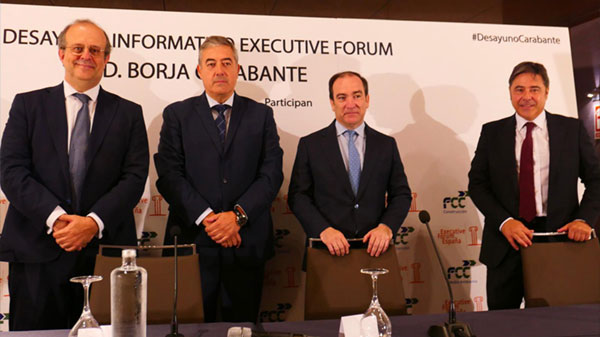
FCC Construcción and FCC Medio Ambiente took part in the breakfast briefing given by Borja Carabante, head of the Madrid City Council's Urban Planning, Environment and Mobility Department, who presented Madrid as a ‘model of success’, analysing the risks and challenges it faces as a ‘global city’ and explaining some of the main solutions the City Council is proposing to address them.
José Antonio Madrazo, manager of Spain, Portugal and the Industrial Area of FCC Construcción, and Javier Rivas, Area Manager of FCC Medio Ambiente, accompanied the Delegate at the meeting. José Antonio Madrazo emphasised Madrid's role as a benchmark, which ‘is being mirrored and monitored by all the international organisations’. He thanked Madrid City Council for its confidence in FCC Construcción, assuring that ‘we will continue to work on the development of the city's and region's infrastructure’.
Borja Carabante began his speech by highlighting Madrid's leading role as a global city, emphasising the importance of its relationship with its metropolitan area. In this regard, he warned that ‘we cannot become complacent or lose our ambition’, which is why it is necessary to continue to promote digital transformation as a lever for Madrid to continue to advance ‘without leaving anyone behind and combining three basic ingredients: innovation, balance and sustainability’.
In this regard, he vindicated the successful model represented by the Madrid 360 Sustainability Strategy in order to address the challenges facing the city and to consolidate it as a national and international benchmark, stressing that ‘we cannot give up on it’. Thus, he insisted on the importance of ‘understanding that social and private initiative must have more space, institutional stability in the Madrid City Council and the regional government and a framework of legal security for those who want to invest and work with us’.
The great challenge of housing
Borja Carabante criticised the current Housing Law and stated that affordable housing is the main objective that public administrations should pursue, as it is ‘the main instrument of social policy that we have’. In this way, he explained that ‘we are using urban planning to unblock land, such as the developments in the southeast, Madrid Nuevo Norte and Operación Campamento. In total, we have unblocked land through 12 plans so that 210,000 homes can be built in the coming years’.
On the other hand, he warned that the Madrid City Council is ‘giving value to the municipal land assets instead of leaving them abandoned’ and announced that on Tuesday next week the Council will approve the application of the regional law that allows the transformation of office land into subsidised housing for rent, which could result in up to 20,000 new homes.
Urban transformation and mobility
In order to make progress on the great challenge of urban transformation in Madrid, Borja Carabante indicated that it is necessary to ‘generate a new, healthier, friendlier and more sustainable physical space’ with more green areas and in which ‘the streets are a place to be and not just a place to pass through’. He also referred to the commitment to integrally incorporate the principles of the environment, urban planning and mobility into the Madrid 360 urban strategy, for which the new General Urban Development Plan will be an ‘essential tool’, as well as being ‘agile, flexible and participatory’, ‘as we have 1997 regulations to build the Madrid of 2030’.
With regard to mobility, the delegate recalled that Madrid has complied with the European directive, becoming ‘the least polluted capital’. This is reflected in ‘the 24 measuring stations, which are below 27 micrograms of NO2; 21 below 25, while in 2019, 19 stations were above 40’. For this reason, he insisted on the success of Madrid 360 and the low-emission zones.
He recalled that ‘the challenge facing large cities is to integrate all modes of mobility, through technology and digitalisation, to make life easier for citizens in terms of economy, time and sustainability’. To continue along these lines, Borja Carabante assured that the model ‘must revolve around public transport’ and, specifically in the city, ‘around the Municipal Transport Company’.