
FCC Industrial produces enough renewable energy at the solar thermal plants (Guzmán and Villena) for over 30,000 families
Since 2012, FCC Industrial has operated and maintained two solar thermal power plants, both with a nominal power output of 49.9 megawatts per hour. The two solar thermal plants, which FCC Industrial also designed and constructed, use parabolic trough collector technology.
The Villena solar thermal plant, located in the Alicante province, covers an area of approximately 200 hectares. It has a solar farm comprising over 141,000 mirrors, which allows for an energy collecting surface area of 360,000 m2.
The Guzmán solar thermal power plant, located in the city of Palma del Río (Córdoba), covers an area of 897,000 m2. Its solar farm comprises over 129,000 mirrors, creating an energy collecting surface area of 310,406 m2.
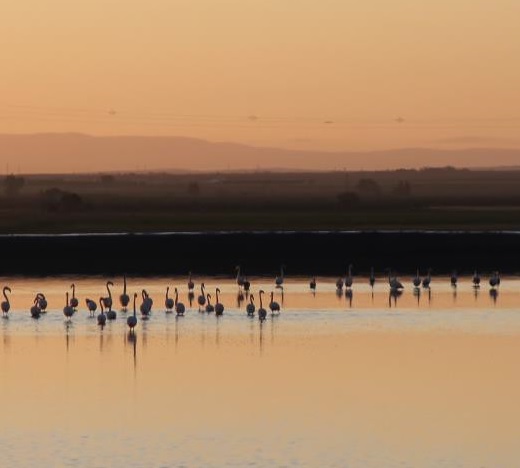
Evaporation basin of the Guzmán solar thermal power plant, used by flamingos as a nesting site.
These solar thermal plants stand as an important milestone that reflects the contribution of FCC Industrial to sustainability and energy efficiency. The two plants together have an annual power production capacity of over 190 gigawatt hours per year, which means it could supply 30,000 families and, approximately, a population of 70,000 residents.
As such, carbon dioxide emissions can be cut, between the two plants, by 106,400 tonnes per year, which is equivalent to the amount of carbon dioxide that a 15,000-hectare forest would absorb.
FCC Industrial, a sustainable company
FCC Industrial, in its operating and maintenance work at its photovoltaic and solar thermal power plants, enables a reduction in carbon dioxide emissions of 119,400 tonnes per year, contributing to the fight against climate change. Regarding Oil&Gas activities, the company has made it possible to reduce carbon dioxide emissions by 250,000 tonnes per year by launching the Mariña-Lucense gas pipeline.
At the Guzmán solar thermal plant, sustainable practices have been implemented, strengthening the environmental policy that FCC Industrial adheres to. Nesting areas for species like the Ciconia nigra (black storks) and the Phoenicopterus (flamingos) were created in the evaporation basin. Entrance and exit access points for birdlife were also made. All these measures have enabled local populations of Ciconia nigra and flamingos to grow.