
FCC puts second tunnel boring machine into operation on Line 5 of the Riyadh Metro
FCC has reached a new milestone at the Riyadh Metro by operating a second tunnel boring machine on Line 5 of the Riyadh Metro. These works are part of a huge project awarded to the FAST Consortium in 2013, of which the Citizen Services Group is the leading company and responsible for the design and construction of Bundle 3, which comprises Lines 4 (orange), 5 (yellow) and 6 (purple).
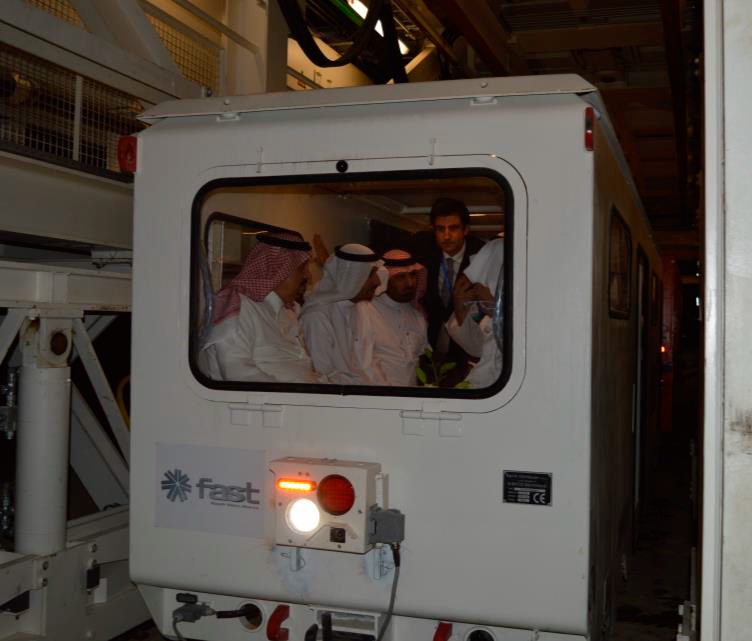
Given that the month of Ramadan was under way, the opening ceremony took place at 11:00 pm on Tuesday 30 June and was chaired by H.R.H. Prince Bandar bin Faisal, Governor of Riyadh, accompanied by H.E. Engineer Ibrahim bin Mohammed Al Sultan, Mayor (Ameen) of the Saudi Arabian capital and Chairman of the Metro Project's Oversight Committee, and by Jaime Freyre de Andrade, Director of the FAST Consortium.
Prince Faisal bin Bandar was responsible for starting the cutterhead of the TBM known as San'Ah (Beauty). The authorities closely followed the progress of the excavation work from above, to then moved to the rail yard. The prince and his entourage were able to access the inside of the tunnel boring machine and observe the process of placing the precast segments from a railcar.
The ceremony was brought to a close with an audiovisual presentation of the features of the line and the current progress. The event, which took place in the festive atmosphere of Ramadan typically seen at night, showed the high level of technical skill of FCC's staff and the commitment of the team, led by a senior figure of the Consortium's management, in what is the largest metro construction project awarded to a Spanish company. The first tunnel boring machine, called Dhafrah, which was first operated on 30 April, has successfully completed more than 600 metres since commencement of the works, reaching production peaks above 30 metres per day. With this milestone, FCC has now two tunnel boring machines in operation and takes another step in the construction of Lines 4, 5 and 6, which represent 37% of the project being carried out in the Saudi city's metro.
To build the three lines awarded under the contract, the FCC-led consortium will use two tunnel boring machines (TBM) with a diameter of almost 19 metres that can excavate tunnels with a circular cross section. Overall, 7 tunnel boring machines will be used to complete the Riyadh Metro project, which stands as the largest underground commuter train network under construction worldwide, covering 176 kilometres and 85 stations.
Out of the €16.3 billion budget, close to €6 billion are used for the works on Lines 4, 5 and 6. For these three lines of the FCC-awarded Batch 3, there are 25 planned stations for which a total of 65 kilometres of metro lines will be required, 35 km of viaducts, 17 km of underground lines and 13 overground lines. 69 conductor-free automatic trains will be also be manufactured to meet the service demands of the three lines.
The first phase of the works began at the start of April 2014 with the excavation of the "4 G1" station at Riyadh King Khalid International Airport, one of the stations that is part of Line 4, which will connect the financial district with the capital's airfield.
The works are expected to be completely finished by late 2018. For the execution thereof, FAST (also made up of Samsung, Alstom, Strukton, Freyssinet Saudi Arabia, Typsa, Atkins and Setec) will employ close to 15,000 workers of more than 33 nationalities. FCC is undertaking the challenge of designing and constructing a first-class metro for the capital of Saudi Arabia, which currently has a population of 5.7 million people. 2% of the population uses public transport, which equates to approximately 7.4 million journeys made daily. The population is expected to rise to 8.3 million people by 2030, therefore the Riyadh Metro will, as well as boosting the local economy, improve the Saudi quality of life.