
The Aranda de Duero Hospital (Burgos) reaches key milestones in its construction
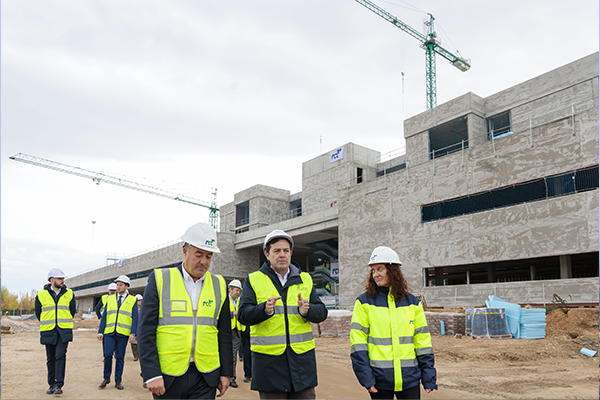
Aranda de Duero Hospital (Burgos) continues to make progress and has reached key milestones in its construction. It is one of the largest hospital projects in Spain and will be a state-of-the-art hospital with modern facilities, which will increase the current portfolio of services offered to a population of more than 55,000 inhabitants in Aranda de Duero and its surroundings.
The new hospital will have more operating theatres, increasing from three to five; an Intensive Care Unit (ICU) with eight beds; a Dialysis Unit with 14 beds; a Home Hospitalization Unit; and all outpatient consultations will be integrated into a single building, increasing from the current 27 to 43.
The project proposes a horizontal building approximately 180 meters long by 130 meters wide and 16 meters high. The first two floors act as a large base on which all healthcare services will be provided, with the two hospitalization floors located above. This area increases the number of beds from the current 111 to 144, of which 18 will be allocated to obstetrics and pediatrics.
The ground floor of the new hospital is expected to house the emergency department, which will increase from nine care points to 39, including the addition of three separate waiting rooms: adult, pediatric and infectious diseases. The Medical Emergency Base is also planned, with an advanced life support ambulance (UME) and the base for Basic Life Support Ambulances.
In addition, the Diagnostic Imaging area, the Day Hospital, which will increase from 10 to 19 beds, Dialysis, Extractions and Rehabilitation, Admissions, Clinical Documentation, the Teaching and Research Area, and part of the outpatient consultations and Pharmacy service will also be located there.
The first floor will house the Management and Administration area; the Examination Rooms, which will increase from 12 to 25; the laboratories; the ICU and the Obstetric Unit, near which the Maternal and Child Hospitalization Unit and the laboratories will be located. This floor will also house the Surgical Block, with five operating theatres, two of which will be for major outpatient surgery, and a post-anaesthesia resuscitation area, which will increase from 3 to 9 cubicles: the surgical day hospital, endoscopy and sterilization area. The project also includes rooms for on-call staff and the Occupational Health service.
Maintenance areas, facilities control centers and the waste unit will be located in a separate block. There are also plans for a heliport, connected to the central building by a walkway.
As an example of its commitment to the environment, the new hospital will install 897 photovoltaic solar panels with more than 300 kW installed, i.e. three times the amount required by regulations. In addition, the flow rates of sanitary appliances will be reduced to promote water savings, as well as the irrigation needs of the landscaped areas of the plot and the building.