
FCC celebrates the 25th anniversary of the LIFE programme with a practical demonstration of the MethaMorphosis project at Ecoparc2 in Barcelona
FCC has been involved since 2014 through MethaMorphosis, within the LIFE programme’s R&D framework, led by FCC Aqualia in partnership with the Barcelona Metropolitan Area (AMB), FCC Medio Ambiente, Gas Natural Fenosa, the Catalan Energy Institute (ICAEN) and SEAT. The objective of this programme is to develop an innovative process to increase the amount of biofuel that can be obtained from municipal and farming waste.
MethaMorphosis, which was selected by the prestigious European LIFE programme in support of actions to mitigate climate change, seeks to increase the production of biogas from the leachate resulting from the treatment of municipal waste, by changing the treatment techniques used as well as introducing new ones. Once enriched, the methane gas resulting from the process will be used as fuel for vehicles, thereby reducing greenhouse-gas emissions. The gas produced may also be introduced into the natural gas network in the future.
The project plans to install and operate prototypes to increase biogas production and enrich its biomethane content at the Ecoparc 2, which is a recycling and mechanical and biological treatment centrefor municipal waste, located in Montcada i Reixac (Barcelona), owned by AMB and managed by FCC Medio Ambiente. These prototypes are based on three innovative FCC Aqualia technologies: an anaerobic membrane reactor (AnMBR), a patented system for the autotrophic elimination of nitrogen (ELAN®) and a patented upgrading facility that will enable enriched biomethane to be obtained from (ABAD®).
This new process will enable the facilities to achieve a high level of efficiency while, at the same time, reducing greenhouse-gas emissions, thanks to cutting the necessary energy demand by 70% and CO2 emissions by 80% compared with conventional systems. In partnership with ICAEN, actions are being undertaken to transfer knowledge from project results and increase its replicability.
MethaMorphosis marks a major step forward in the energy recovery from waste and a significant proposal for the circular economy, turning a waste-treatment centre into a fuel producer with the capacity both to power vehicles and to supply the distribution network.
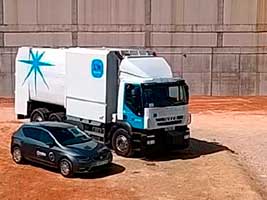
The efficiency of enriched biomethane will be demonstrated by using it in SEAT vehicles, monitored by the SEAT Technical Centre, as well as in other vehicles from FCC Medio Ambiente’s fleet that are powered by natural gas, in a series of tests totalling more than 120,000 kilometres.
The tests with FCC Medio Ambiente’s vehicles will be carried out in real operational conditions. It is expected to reduce greenhouse-gas emissions by 30% compared with diesel. The effect of the use of biomethane on performance, engine parts, consumption and emissions by the fleet of test vehicles will also be assessed, compared with the available data on the use of conventional natural gas.
Thus, the FCC Group is committed to exploring the development of fuel from renewable energy sources that is cleaner and environment-friendlier than the current liquid fuels, with lower emissions of particles that are harmful for health, while helping to reduce dependence on fossil fuels. This project is a clear expression of FCC’s technological-innovation policy, focused on enhancing the provision of smart services for the public and the practical application of synergies derived from the combined experience of our different business divisions — in this case, water management and environmental services.