
FCC Construcción completes boring of the Bolaños tunnel on the Madrid-Galicia high-speed line
FCC Construcción has completed the boring of the Bolaños tunnels (Verín-Ourense). The works entail the execution of two parallel single-track tunnels, each 6.7 kilometres long, on the Madrid-Galicia High-Speed Line.
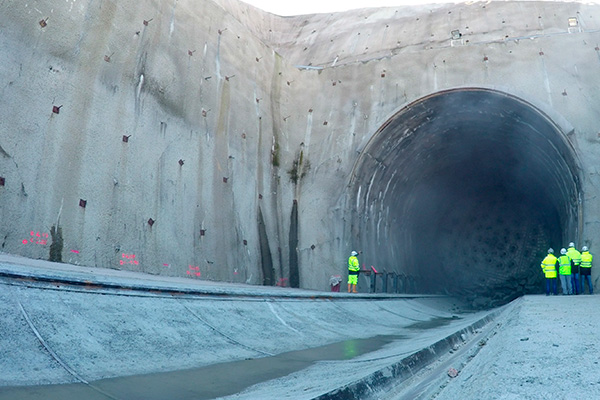
With an average excavation performance of 19.40 linear metres per day in the first tunnel, the work took 11.5 months to complete. The boring of the second tunnel saw an average excavation performance of 24.32 linear metres per day, resulting in a completion term of 9.5 months. Therefore, there was a two month reduction with regards to the time invested in the first tunnel.
An R&D&I solution was implemented in the construction of the tunnels based on applying a stabilisation system for land of high geological instability. The excavation diameter is 9,900 mm and the useful cross-section 60.27 m². The tunnel was lined using precast segments that are 370 mm thick and 1,600 mm long. The machine used for the excavation was a single shield tunnel boring machine manufactured by Herrenknecht in Germany.
According to the CEO of the FCC Group, Carlos M. Jarque, “FCC Construcción has built up extensive experience and technical knowledge in transport infrastructure that has increased the company's competitiveness and internationalisation in the rail sector”.
FCC Construcción has built over 99 kilometres of AVE in Galicia, undertaking unique projects such as the Bolaños Tunnel or the Vigo-Das Maceiras Tunnel with a length of 8.5 kilometres.
Over 700 High Speed kilometres
FCC has laid down over 700 kilometres of high speed lines, with over 550 kilometres of tunnels built. The company has operated over twenty tunnel-boring machines, the most important being: the Dhafrah and San´ah tunnel-boring machines (Line 5 of the Riyadh Metro); two tunnel-boring machines for Line 2 of the Lima Metro; two tunnel-boring machines for Line 5 of the Bucharest Metro; the Tizona tunnel-boring machine used for the Madrid Calle 30 tunnel; the Adelantada tunnel-boring machine used on several lines of the Madrid Metro (L7-L2-L12-L8, airport T1-T4), and the Virgen del Camino tunnel-boring machine that played a part in the Pajares tunnels.
FCC's tunnel construction portfolio has been made possible thanks to the development of technological solutions contributing to sustainability, safety, profitability, system optimisation and process improvement in these projects.