The “0 ACCIDENTS” Project Reaches Its Final Phase
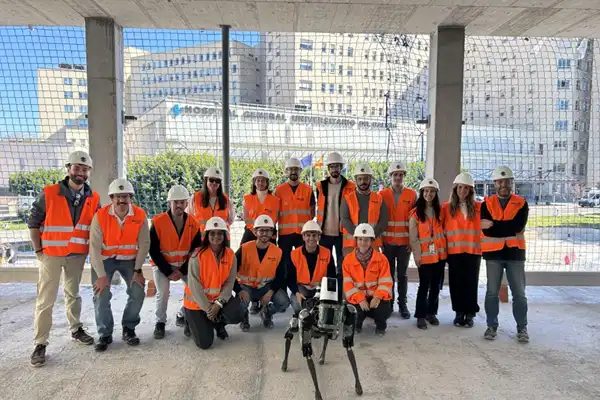
The “0 ACCIDENTS” project has successfully completed the final validation tests in real construction scenarios. These tests were carried out in two settings: the Tenerife Ring Road project, where FCC Construcción is executing a large-scale tunnel; and a BECSA building project in Alicante. Both projects consolidate a technological ecosystem designed to minimize risks in high-altitude construction and linear underground works.
Both tests brought together representatives from the eight companies that make up the consortium: BECSA, FCCCO, Alisys, Signe, IDP, LIS Data, Fractalia, and MEPLASJAR, as well as the Technology Centers ITA, CETIM and AIMPLAS. During the visits, partners were able to validate the performance of the systems in a controlled real environment, with the goal of integrating all project developments into the tests.
Tenerife Ring Road: Safety in Tunnels and Enclosed Environments
In the Tenerife Ring Road project by FCC Construcción, advanced capabilities were demonstrated to protect workers in underground and highly complex environments. The main focus was the creation of a connected work environment:
- Pedestrian Impact Prevention: Through a multi‑agent perception system (sensors on heavy machinery and fixed posts), a digital representation of the environment was created to predict collisions and send real‑time alerts to machinery operators.
- Air Quality Digital Twin: A model was validated to predict pollutant concentrations in confined spaces, enabling optimization of ventilation systems and protecting workers’ health.
- Intelligent Data Management: All the infrastructure to integrate this information was developed by Big Data specialists, allowing safety technicians to consult incidents and risks through a centralized digital platform.
Illustration: Tests carried out in the Tenerife Tunnel by FCCCO.
Illustration: Sensors installed to power the deployed technologies. Sensorized pole (left) for detecting pedestrian accidents and collisions, and gas sensors (right) for air quality monitoring.
Illustration: Real-time pollutant distribution maps powered by physical sensors
Validation in Alicante: Robotics and PPE Control
In this BECSA project for the new research building at Alicante Hospital, the latest‑generation robotic “Spot” was used to autonomously inspect the site. The main goal was to validate the following solutions:
- Multi‑floor Autonomous Navigation: Validation of 3D map generation and its conversion into 2D maps for the robot dog's autonomous navigation during multi‑level inspection tasks.
- Automated Safety Compliance Detection: Use of “Spot” to detect failures in the use of personal protective equipment (PPE) and in collective protection elements on site.
- Smart PPE: Final testing of the smart helmet and smart harness, designed to ensure proper anchoring of workers to lifelines.
- Real Prototype Validation: Testing of the integrated system under real site conditions to ensure its effectiveness before full deployment.
All information generated by the sensors, air‑quality controls, “Spot,” and predictive models is integrated into a comprehensive management platform. This tool centralizes all technological developments of the project, enabling smart and automated decision‑making to achieve the goal of zero accidents in the construction sector.

Illustration: Tests carried out on a BECSA construction site.
Illustration: Spot integrated with LiDAR system and RGB camera.
Thanks to the synergy between Artificial Intelligence, mobile robotics, and digital twins, the project funded by CDTI demonstrates that digitizing occupational risk prevention is possible. The success of these demonstrators positions the Spanish construction sector at the forefront of 4.0 technology, always oriented toward the goal of zero accidents.