
FCC Construcción participates in the "Session on business opportunities relating to international events", organised by the ICEX
On Thursday, FCC participated in the "Session on business opportunities relating to international events", which was organised by the Spanish Institute for Foreign Trade and held at its headquarters in Madrid.
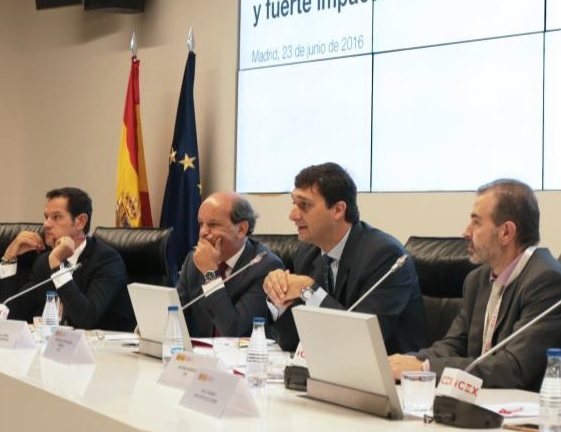
Antonio Burgueño, the Quality and CSR Manager, was given the chance to explain the extensive experience of FCC Construcción in that area, having carried out over 25 construction projects and participated in the main international cultural and sporting events.
The most noteworthy projects in the area of culture include the construction of emblematic buildings, such as those undertaken for the Expo 92 in Seville, specifically, the Catalan, Italian and Puerto Rican pavilions; those undertaken for the Expo de Zaragoza 2008, including the River Aquarium pavilion, the Bridge pavilion and the Water Tower; and the Crystal Palace in Baku, home to Eurovision 2012.
Regarding sports facilities, Antonio highlighted the participation of FCC in the biggest events in the sport category, such as the construction of the Allianz Arena for the 2006 World Cup in Germany; the construction of the Wörthersee and Tivoli stadiums, and the extension of the EM Wals-Sieznheim stadium for Euro 2008 in Austria; the construction of the PGA Arena in Gdańsk, the National Stadium in Warsaw and the Municipal Stadium in Poznań for Euro 2012 in Poland; and the construction of the International Broadcasting Centre for the 2012 Olympic Games in London, as well as other infrastructures relating to Madrid's bid for the Olympic Games, including the La Peineta stadium, on which work is currently ongoing.
The uniqueness of these types of projects determined the solutions that were adopted, using the most advanced technology with a traditional construction basis and under a paradigm of efficiency.
This session was held to present a new line developed by the ICEX, which aims to identify business opportunities arising from major international sporting and cultural events in any business aspects (investment projects, tenders, public and private contracts, subcontracting, etc.), as well as to assess potential companies interested in improving their competitiveness.
International sporting and cultural events, such as the Summer and Winter Olympic Games, the FIFA football World Cups and universal and international expositions (of shorter duration than those first mentioned), have become an industry in themselves, having a significant impact on the economies of host cities and countries and, as a knock-on effect, on the world economy.