
“CLIMPORT” is born, a research project on the effects of climate change on the design and construction of port infrastructure
- One of the impacts of CLIMPORT will be to position the Spanish port sector as a leader in technologies adapted to climate change in the field of port design and construction.
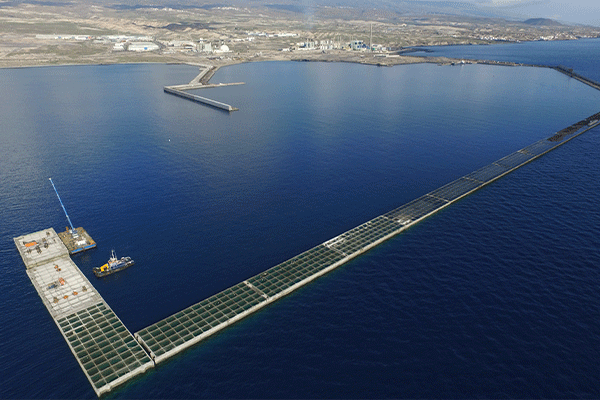
Due to their long lifespan and coastal location, port infrastructure is especially vulnerable to the effects of climate change. Given this evidence, the need arises to establish new methodologies for the design and construction of ports that take into account the effects associated with climate change.
To address this problem, the project titled “Modeling system for the design and construction of port infrastructures adapted to Climate Change” (CLIMPORT) was formulated; which has been co-financed within the call for Public-Private Partnership Projects 2022.
The execution of CLIMPORT is carried out by a public-private consortium, led by FCC Construcción, and made up of the Institute of Environmental Hydraulics of the University of Cantabria (IHCantabria), three large construction companies (FCC Construcción, DRAGADOS and ROVER Maritime) and three large engineering companies (the ACCIONA Engineering area, the Sener engineering and technology group and the Amper Group engineering area, PROES Consultores), which have extensive experience in the field of engineering and maritime works. The execution period of this project covers from October 1, 2023 to September 30, 2026.
This project aims to design and build port infrastructure adapted to climate change, so it will research and develop an innovative system that considers the effects of climate change in the design of resilient port structures, which is essential to guarantee sustainable mobility. .
It will generate an innovative modular system that will incorporate new professional methodologies for the design and construction of port infrastructure, integrating statistical tools, databases, international regulations and state-of-the-art construction procedures.
One of the innovative elements of the CLIMPORT project is that it explicitly adds the analysis of risks associated with climate change; Another innovative element is the integration of variables to design and build ports, considering different temporal and spatial scales, which represents a unique approach in the international arena.
Key aspects of the CLIMPORT project include: the analysis of climate risks in the design and construction of ports, incorporating the effects of climate change and quantifying the uncertainty of the results; the development of the digital twin of the port's hydraulic behavior, for different phases of its life cycle; cooperation with the BIM philosophy; the modular system that allows for great versatility and scalability and the characterization of the potential of renewable energy in ports.
Participation in this project demonstrates the corporate social responsibility of all partners of the public-private consortium. This can be seen because the execution of CLIMPORT is aligned with the Sustainable Development Goals (SDGs), especially with SDG 9 (Industry, Innovation and Infrastructure) and with SDG 13 (Climate Action). Furthermore, the system to be developed will be a benchmark in the design and construction of resilient port infrastructures, which will reinforce the international competitiveness of the Spanish Science, Technology and Innovation System.